Find Out the Five Love Languages With an Online Test
Why the Love Languages Test Endures
Romantic and platonic bonds flourish when signals of care are translated into actions that feel unmistakably personal and timely. In everyday conversation, people refer to the spectrum of expressions as love language types, blending psychology with practical habits. The concept emphasizes that affection is not just felt but also demonstrated through specific, repeatable behaviors. When partners learn to express appreciation in the way the other instinctively receives it, misfires decline, and goodwill compounds.
Although the model grew from counseling practice, its utility now stretches across friendships, families, and even collaborative teams. Across cultures and age groups, researchers map how partners benefit from types of love languages, because naming patterns clarify behavior. By giving names to patterns, the framework lets people discuss needs without blame and make small, testable adjustments. Over time, this shared vocabulary reduces defensiveness, supports empathy, and turns guesswork into thoughtful experimentation.
- It provides a neutral language for sensitive topics and unmet needs.
- It encourages micro-actions instead of vague promises about “trying harder.”
- It helps track progress, so couples notice what actually moves the needle.
The Five Languages in Depth
Even the strongest relationships can stall when care is expressed in a dialect the other person doesn’t readily hear. Beyond simple preference, historians catalog different types of love, from eros and philia to pragma and agape, to contextualize affection. This broader backdrop explains why some people light up at heartfelt words while others relax only when plans turn into concrete deeds. Matching expression to reception keeps emotional fuel flowing.
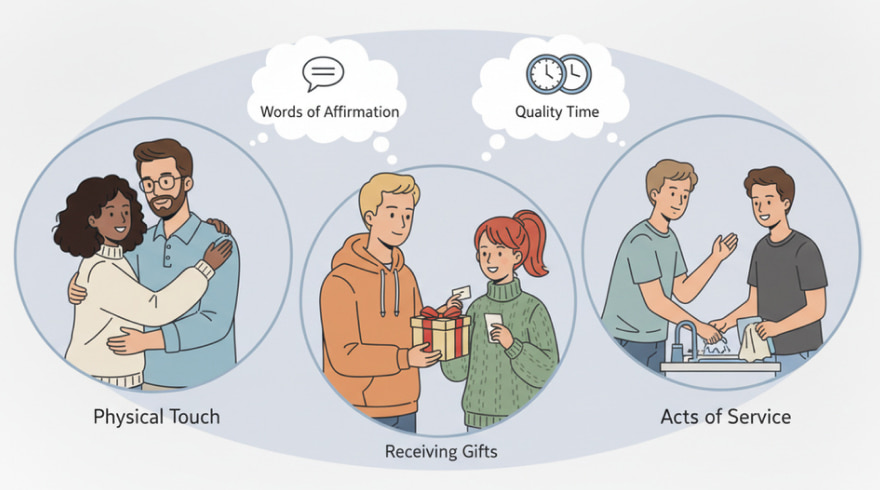
Each modality corresponds to a distinct need, and using them deliberately prevents accidental neglect. Within this framework, coaches describe five modalities as types of love language, each addressing a distinct relational need. Words of Affirmation highlights appreciative language and specific praise. Quality Time emphasizes undivided attention and shared presence. Acts of Service converts intention into visible help. Physical Touch anchors safety and connection through appropriate contact. Receiving Gifts symbolizes thoughtfulness through tangible tokens.
- Words of Affirmation: highlight wins, speak gratitude, and avoid sarcasm.
- Quality Time: protect calendars, remove distractions, and practice deep listening.
- Acts of Service: anticipate chores, close loops, and deliver on commitments.
- Physical Touch: secure consent, read comfort levels, and be consistent.
- Receiving Gifts: mark milestones, personalize tokens, and keep symbolism meaningful.
Core Benefits, Communication, and Conflict Repair
Relationship satisfaction rarely hinges on grand gestures; instead, it accumulates through small, predictable signals that feel tailor‑made. When couples disagree, they often confuse signals flowing across different types of love language, which amplifies friction. For example, one partner may clean the kitchen to convey care while the other waits for a heartfelt compliment, and both miss the other’s effort. Clarifying intentions reduces this mismatch and restores goodwill.
Once aligned, couples create a feedback loop: needs are voiced, actions are chosen, and appreciation is reinforced. Workshops help families coordinate routines across different types of love languages, aligning intentions with actions. This alignment lowers chronic stress, improves daily cooperation, and builds resilience after conflict. Over time, the partnership becomes less about decoding and more about reliably meeting needs, which strengthens trust and promotes long‑term stability.
- Stronger emotional safety due to predictable, respectful communication.
- Fewer recurring arguments because practical remedies replace assumptions.
- Greater intimacy as partners witness and validate each other’s inner world.
Finding Your Profile and Using Assessments Wisely
Discovery should feel curious rather than clinical, so start with observation: What makes you feel cherished without effort? You might try a printable types love languages test, yet your reflections afterward matter even more for accuracy. Track moments that energize you during a normal week, and look for patterns in what you requested, noticed, or replayed in your mind. Invite your partner to do the same, then compare notes with kindness.
Screening tools can spark insight, but lived behavior is the gold standard for change. For rigor, therapists sometimes combine a validated types of love languages test with interviews and behavior sampling. This mixed approach balances quick results with real‑life nuance, especially when stress, culture, or neurodiversity shape how signals are sent and received. Ultimately, evidence comes from experiments you repeat and refine together.
- Journal “high‑connection” moments and decode what made them work.
- Design weekly rituals that deliberately engage your top two preferences.
- Review outcomes and adjust, just as you would with fitness or budgeting.
Quick Comparison and Practical Moves
Clarity improves when you can see the map at a glance, then choose one or two actions to try today. As a fast refresher, educators often summarize the 5 types of love language with concise verbs that cue behavior. Below, the side‑by‑side view turns abstract ideas into concrete, doable habits that can be scheduled, tracked, and celebrated without guesswork.
| Language | Core Need | Practical Moves |
| Words of Affirmation | To feel seen through sincere language | Send a specific compliment; write a short note; celebrate small wins |
| Quality Time | To receive undivided attention | Schedule distraction‑free walks; share meals; plan mini adventures |
| Acts of Service | To experience care through helpful action | Tackle a nagging task; prep meals; handle logistics without prompting |
| Physical Touch | To anchor connection through contact | Offer a hug; hold hands; relax together with mindful closeness |
| Receiving Gifts | To feel remembered through tokens | Choose symbolic items; mark dates; create keepsakes with a story |
Momentum grows when you translate insight into micro‑commitments that fit your schedule and energy. To set intentions for the week, you can assign micro‑goals that touch all 5 types of love languages, then review outcomes. Pick a single cue per day, measure impact with a simple check‑in, and iterate based on what consistently generates warmth, ease, and delight.
FAQ: Practical Answers for Everyday Connection
How can partners disagree less while staying close?
Begin by separating intent from impact, then ask which cues land as nourishing rather than neutral. For context, psychologists distinguish personality from love types, because preferences for affection can shift across situations. That distinction reduces blame and makes room for experiments that honor both people’s needs.
Can one person have more than one primary language?
Yes, many people have a clear favorite and a strong secondary that fluctuates with stress or life stage. If you notice seasonal changes, pair your top two and create routines that reliably serve both without excessive effort. Balanced rituals reduce burnout and keep the bond resilient.
How do we start without making it feel mechanical?
Use tiny, predictable actions and narrate what you are trying, including why it matters to you. If you are starting from zero, you may wonder what are the different types of love languages, and the short answer points to five fundamental patterns. Once named, you can test one small behavior per day and track how it feels.
What if our preferences clash?
Trade small favors and rotate emphasis across the week so no one’s needs are perpetually sidelined. Create a shared calendar for gestures, then review what worked during a calm moment. Mutual stewardship replaces score‑keeping with teamwork, which strengthens goodwill over time.
How should we measure progress?
Favor simple metrics such as weekly check‑ins, reduced misunderstandings, and faster repair after conflict. Short debriefs reveal which actions produce the biggest lift in connection, making it easier to double down on what works. Over months, you should notice greater trust, ease, and affectionate spontaneity.